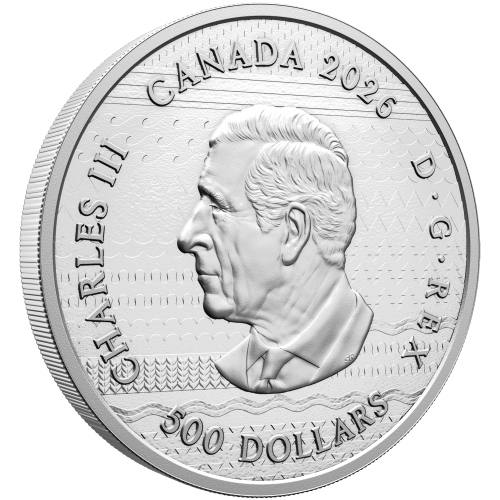
5 kilo 2026 Heraldic Landscape: Animals of Canada Proof Silver Coin | Royal Canadian Mint
Related products
Where heraldry meets natural majesty: Discover Canada through its fauna.
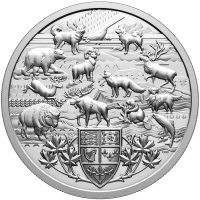
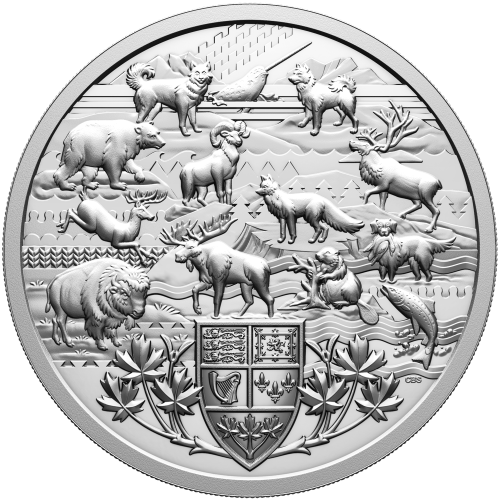
The follow-up to 2024’s Heraldic Landscape: Birds of Canada, this limited-edition work of art crafted in five kilograms of 99.99% pure silver presents a heraldic-inspired vision of Canada, told through its fauna. Thirteen animals, each chosen for its heraldic or historic significance to its province or territory, are arranged to lead the eye on a symbolic journey across the nation—from the Arctic down to the Pacific, through the mountainous west, across the heart of the prairies, into the mighty forests, and ending on the Atlantic coast.
Created by Cathy Bursey-Sabourin, the renowned heraldic artist behind the modern rendition of the Arms of Canada, this grand (180 mm) masterwork is a portrait of unity in natural diversity, where every line carries the quiet weight of history and the enduring pride of place.
Thirteen animals, one shared story told on a five-kilo coin.
COIN HIGHLIGHTS
- Images of Canada. Thirteen iconic animals form an inspiring pictorial representation of Canada—our landscapes, our provinces and territories—in a masterwork uniting history, heraldry, and exquisite craftsmanship.
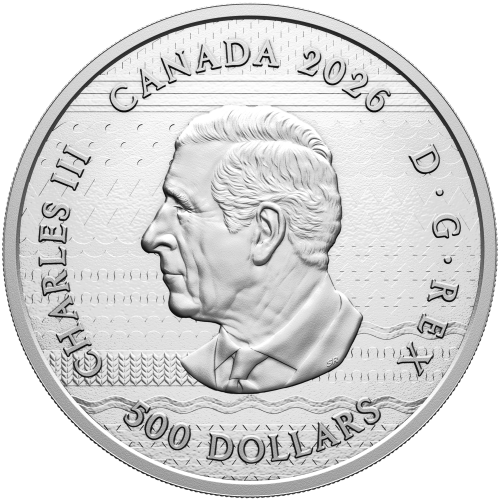
- A five-kilo canvas. At a generous 180 mm, this five-kilogram 99.99% pure silver coin offers the perfect canvas to appreciate every intricately engraved detail—nothing is lost and every meaning shines through.
- Heraldic Canada. As seen on 2024’s Heraldic Landscape: Birds of Canada, this pictorial representation of Canada includes heraldic division lines and motifs that evoke some of Canada’s distinctive landscape features, from sea to sky.
- A prestigious addition. Exquisite art with a low mintage: only 120 of these engraved masterpieces are available to collectors worldwide.
- Includes serialized certificate. The Royal Canadian Mint certifies all of its collector coins.
PACKAGING
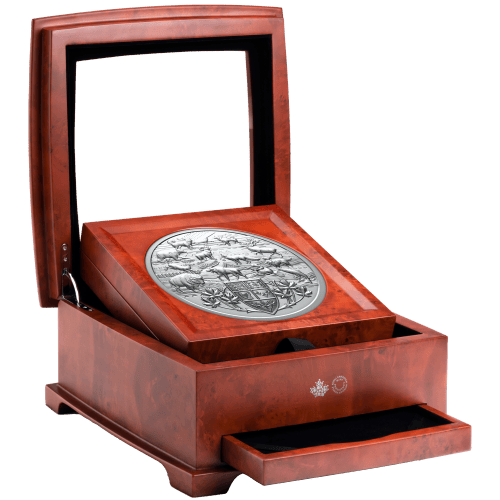
Accompanied by a special certificate in the form of a booklet, your coin is encapsulated and elegantly presented in a wooden Royal Canadian Mint-branded case.
RENOWNED HERALDIC ARTIST
Your coin’s reverse was designed by the renowned Canadian heraldic artist who created and drew the modern rendition of the Canadian Coat of Arms, Cathy Bursey-Sabourin.
SUPREME CRAFTMANSHIP
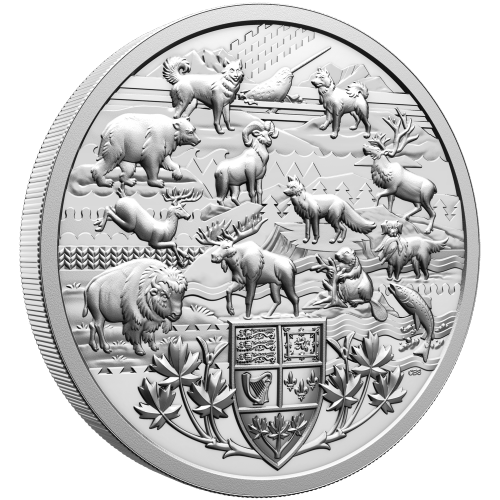
In heraldry, all details are significant, even the smallest line. Your coin’s reverse features a complex design and very finely engraved details that stand out thanks to the use of intricate frostings.
LUXURY PACKAGING
Each coin comes packaged in a high-grade wooden presentation case with a special certificate in a booklet format.
DID YOU KNOW?
Not every Canadian province and territory has an official designated animal—but many do, and in this design, some animals were chosen for their cultural significance or regional associations. Several also appear in the arms of other provinces and territories; for example, the beaver (representing Quebec here) also appears on the coat of arms for Manitoba and Alberta, and serves as an official symbol of Canada.
In this reverse design by Canadian heraldic artist Cathy Bursey-Sabourin, the shield from the Arms of Canada anchors a heraldry-inspired representation of Canada. Quartered to represent England, Scotland, Ireland and France, the shield features three maple leaves that symbolize all Canadians; these inspired the maple boughs that frame the shield, with the addition of maple keys to represent future growth.
Above the shield, 13 Canadian animals drawn in a heraldic style form a pictorial representation of Canada’s provinces and territories, coupled with heraldic stylizations and division lines that evoke Canada’s distinctive landscape features. These are arranged by region in a counter-clockwise order, starting at the top-right: a Canadian Inuit dog (Nunavut); a barry pattern for the Arctic Ocean and the ice floes in Canada’s north; a narwhal (Northwest Territories); angled lines raguly evoking the aurora borealis; an Alaskan Malamute husky (Yukon); a line wavy crested for the Pacific coast; a spirit (Kermode) bear (British Columbia); a line engrailed for the waves of the Pacific Ocean; a line dancetty for the Rocky Mountains; a bighorn sheep (Alberta); a line nebuly reminiscent of the foothills of the Rockies; a line invected for the round hills of the coulee landscape transitioning to grassland; a white-tailed deer (Saskatchewan); a tapissé of wheat for the prairie landscape; a plains bison (Manitoba); lines dovetailed for the grasslands of Manitoba; a moose (Ontario); a barry wavy pattern for the lakes of Central Canada, the Great Lakes and the Canadian Shield; a beaver (Quebec); Atlantic salmon (New Brunswick); a line nebuly for the high tides of the Bay of Fundy; a Nova Scotia duck tolling retriever (Nova Scotia); a red fox (Prince Edward Island); a line sapinée for Canada’s vast forests; a woodland caribou (Newfoundland and Labrador); and a line engrailed resembling the waves of the Atlantic Ocean.
ABOUT THE ROYAL CANADIAN MINT
The Royal Canadian Mint is known as one of the most reputable mints in the world. The Ottawa Branch of the Royal Mint opened in 1908 and was renamed The Royal Canadian Mint in 1931 when control was transferred to the Canadian government. Their high standards for excellence and quality allowed them to be the first refinery to manufacture 9999 fine gold bullion coins in 1982, as well as the first to reach 99999 fine gold purity in 1998.